NAT environments
A NAT environment is a network configuration that
-
uses network address translation (NAT) to transmit and receive network traffic by reassigning source or destination IP addresses,
-
enables private networks to communicate with the internet, and
-
requires NAT IDs and registration keys for device authentication and registration when IP addresses are unavailable, especially behind port address translation (PAT) routers.
NAT ID usage in device registration
Devices and management centers use NAT IDs and registration keys to establish trust and authenticate when only one IP address is available.
-
Both IP addresses and registration keys are typically needed for routing and authentication.
-
If only one IP address is known, a unique NAT ID must be specified on both sides to establish trust and look up the correct registration key.
-
The management center and device use the registration key and NAT ID (instead of IP addresses) to authenticate and authorize for initial registration.
To simplify adding multiple devices, specify a unique NAT ID for each device while leaving the IP address blank on the management center, and specify both the management center IP address and NAT ID on each device.
Note | The NAT ID must be unique for each device to ensure proper authentication and registration. |
Examples of NAT ID usage in PAT environments
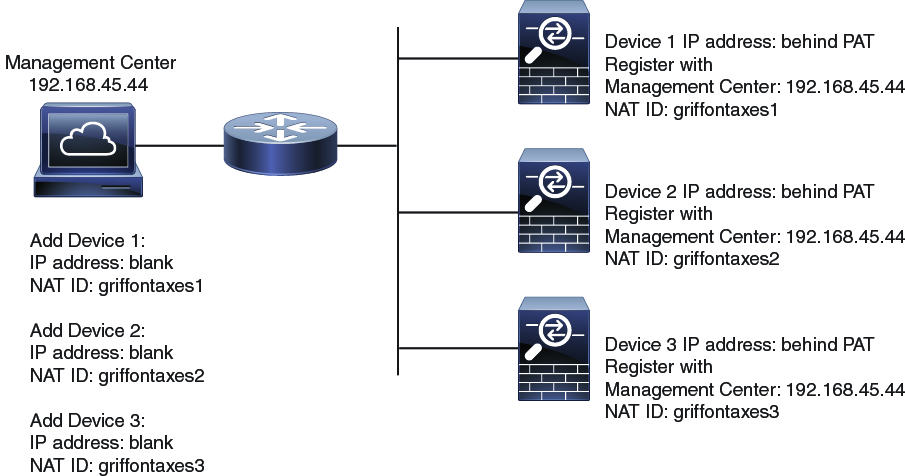
Each of the three devices behind a PAT IP address requires a unique NAT ID on both the management center and the devices. The management center IP address must also be specified on each device.
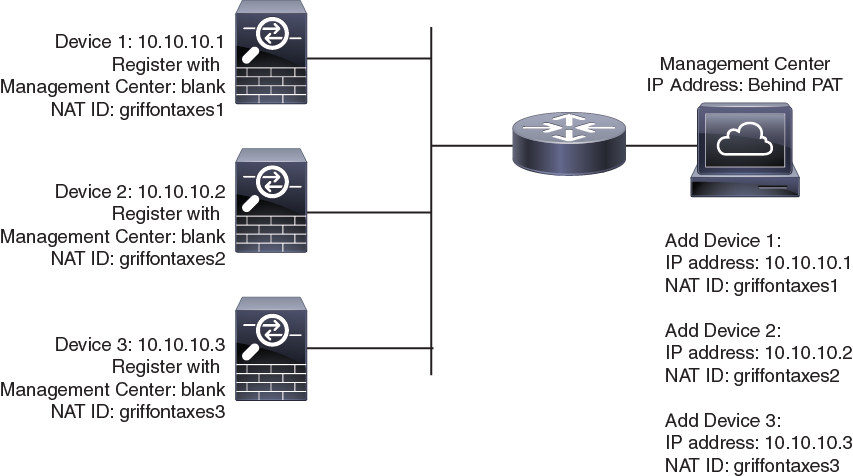
The management center behind a PAT IP address requires a unique NAT ID for each device on both the management center and the devices. The device IP addresses must also be specified on the management center.