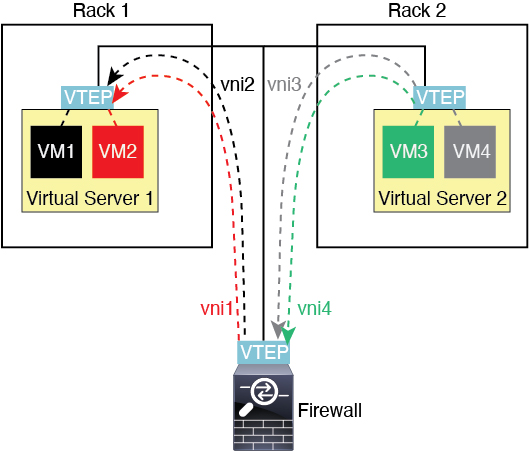
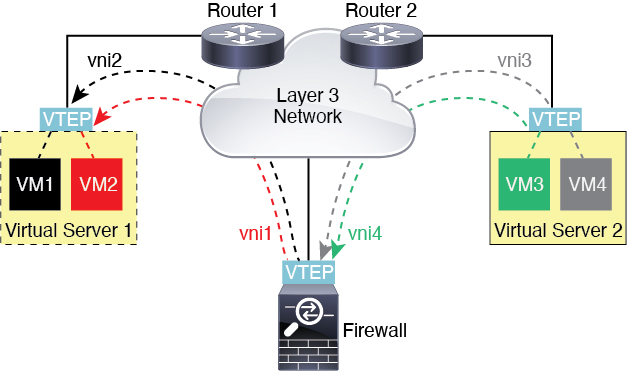
Router Between VXLAN Domains
A VXLAN-stretched Layer 2 domain enables a VM to utilize a Firewall Threat Defense as its default gateway regardless of physical proximity.
Routing Process and Packet Flow
The following steps outline the packet flow between VMs across VXLAN domains:
-
For packets from VM3 to VM1, the destination MAC address is the Firewall Threat Defense MAC address, because the Firewall Threat Defense is the default gateway.
-
The VTEP source interface on Virtual Server 2 receives packets from VM3, then encapsulates the packets with VNI 3’s VXLAN tag and sends them to the Firewall Threat Defense .
-
When the Firewall Threat Defense receives the packets, it decapsulates the packets to get the inner frames.
-
The Firewall Threat Defense uses the inner frames for route lookup, then finds that the destination is on VNI 2. If it does not already have a mapping for VM1, the Firewall Threat Defense sends an encapsulated ARP broadcast on the multicast group IP on VNI 2.
-
The Firewall Threat Defense encapsulates the packets again with the VXLAN tag for VNI 2 and sends the packets to Virtual Server 1. Before encapsulation, the Firewall Threat Defense changes the inner frame destination MAC address to be the MAC of VM1.
-
When Virtual Server 1 receives the VXLAN packets, it decapsulates the packets and delivers the inner frames to VM1.
Note | The Firewall Threat Defense must use dynamic VTEP peer discovery because it has multiple VTEP peers in this scenario. |