End-to-end process for deploying Threat Defense Virtual cluster on AWS
Provides a workflow to help users successfully deploy and verify a Threat Defense Virtual cluster on AWS using either template-based or manual deployment processes.
Template-based Deployment
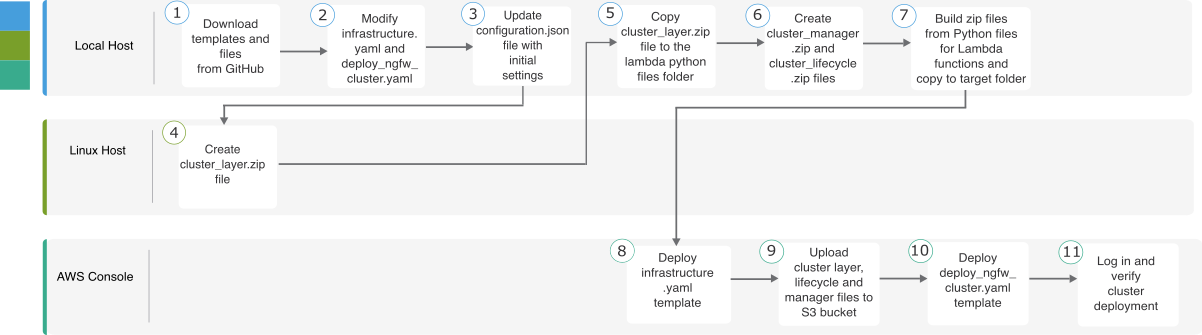
The following flowchart illustrates the workflow for template-based deployment of the Threat Defense Virtual cluster on AWS.


Manual Deployment
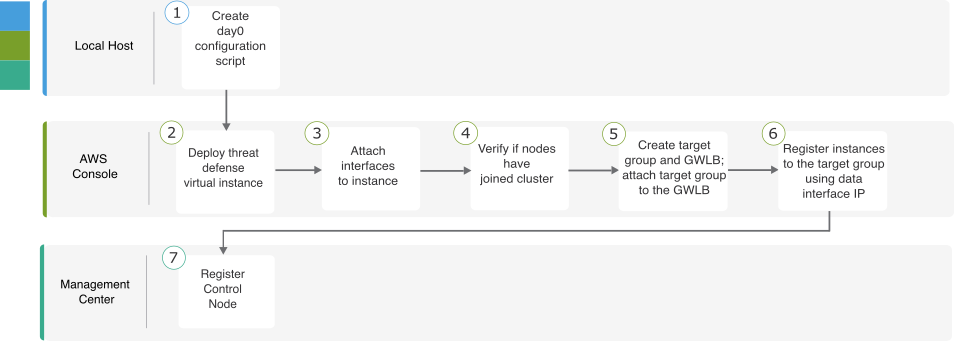
The following flowchart illustrates the workflow for manual deployment of the Threat Defense Virtual cluster on AWS.
|
Workspace |
Steps |
|
|---|---|---|
 |
Local Host | Create day 0 configuration script. |
 |
AWS Console | Deploy Threat Defense Virtual instance. |
 |
AWS Console | Attach interfaces to instance. |
 |
AWS Console | Verify if nodes have joined cluster. |
 |
AWS Console | Create target group and GWLB; attach target group to the GWLB. |
 |
AWS Console | Register instances with the target group using data interface IP. |
 |
Management Center | Register control node. |